Coding|29 October 2026
At Resolute Education, we believe young people learn best when they get to build. That belief took centre stage on 12 September 2026, when nine participants arrived at Heartfelt Arena in Pretoria for the first Roboticon AI Game Hackathon.
Their challenge: design and build a playable educational game in four hours, using AI tools. No coding experience was needed, only an idea, some curiosity and the willingness to keep prompting until it worked.
By the end of the day, every participant had a game to show. Here is how it worked, what they built and what we learned.
The brief was simple on purpose: build an educational game that teaches a real classroom concept and is fun enough that a learner would want to play it again. The subject was up to each participant, and everyone worked individually.
We provided the laptops, the Wi-Fi and the AI tools, such as Google AI Studio. After a 30-minute briefing on AI-assisted coding and game design, participants had four hours to build. Each then demoed their game to a judging panel, and the top three presented again on stage.
Judges scored every game out of 100, weighing educational value and engagement most heavily, followed by game design, a working demo and presentation. The golden rule: a quiz dressed up as a game would not cut it. The learning had to be built into the play.
Nine participants, Nine games, and plenty of variety. Here are a few highlights.
One participant rebuilt the arcade classic with a mathematical twist. The function you choose changes how your shots fly: a straight line, a parabola, or an exponential decay that can work against you as you try to clear the invaders. It leaned more towards fun than formal teaching, but it showed why different functions behave differently, with good graphics and neat gamification to match.
A couple of participants built their own takes on Flappy Bird, weaving digital literacy skills and maths concepts in between the flaps.
Another participant wrapped multiple-choice questions in an escape room set inside a house. The questions were familiar, but the setting and strong visuals made it feel immersive, a good reminder that presentation changes how a learner engages.
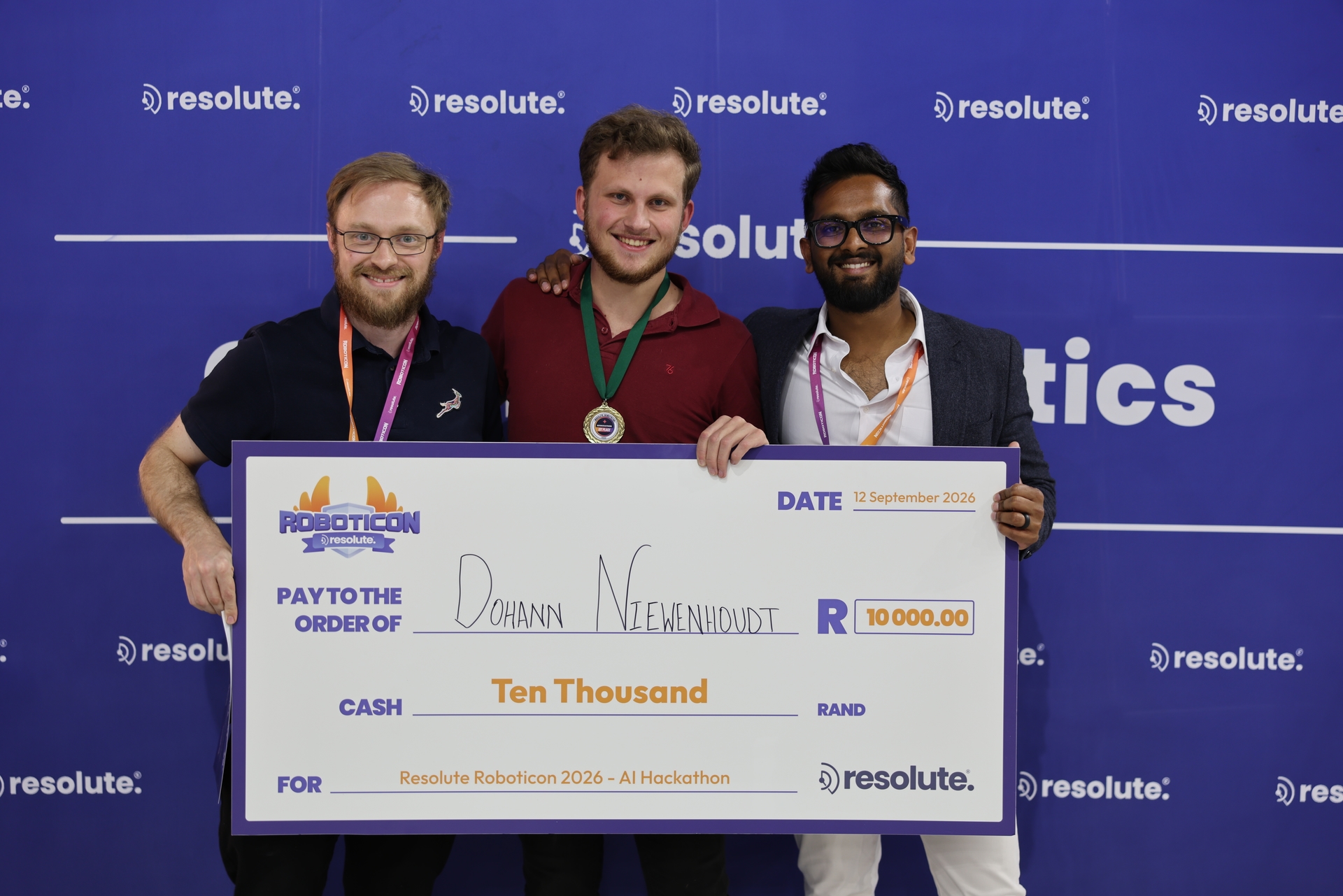
Our winner took a different route. Instead of a single game, they built a full digital literacy learning journey, starting with how to use a mouse and working up to light block-based programming to solve small puzzles.
Each mini-game had real depth and thought behind it, and the project pulled in elements of the CAPS curriculum. The graphics could use more polish, but for four hours of work it was very impressive.
What stood out most was that they were one of the only participants to picture their game in a real classroom. Seeing a young builder think like a teacher was the most exciting moment of the day for us.
They walked away with the R10 000 first prize.
As a first run, the day taught us plenty. We are sharing it so other schools and organisations can plan around it.
Turnout beat expectations, so we rearranged the venue and brought in extra laptops on the morning.
Reliable Wi-Fi and smooth account sign-in make the biggest difference to how much build time participants get.
Capable devices matter. Some entry-level laptops struggled, and one participant kept prompting without a live preview. When we launched her game on a stronger machine it worked, and she presented it with real confidence.
The good news is how little this kind of event needs: tables, power, internet and a few capable laptops. Get those right and the participants do the rest.
Nine participants, four hours, and nine working games, with no coding experience required. That tells us AI-assisted building is already within reach of today's learners, and that their ideas are the real engine.
We're already planning a bigger and better version, and we don't intend to wait for next year's Roboticon to run it. Our next post will cover what we'd change, how we plan to grow the competition, and how schools can run their own.
A big thank you to every participant, and to everyone who helped bring the day to life.
Have an idea for an educational game, or want to host a hackathon at your school? Keep an eye on this space.